


 Menu
Menu



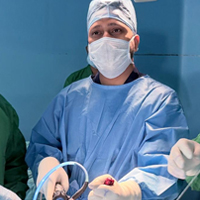
Dr. Bijay Kumar Sahu
Orthopaedic Surgeon
Questions? We’re here to help! Fill the form or chat with us now.

Advanced Shoulder, Knee & Upper Limb Care with Dr. Bijay Kumar Sahu

Arthritis commonly affects the acromioclavicular joint.
AC Joint pain may not be localised to the AC joint. Pain is worse when lifting the arm overhead and there is often a tender bony lump over the top of the shoulder where the AC joint lies if it is arthritic.
Most AC joint pains will settle with rest and simple pain tablets likePanadol and Ibuprofen. If it doesn’t, a cortisone injection can be placed into the AC joint under ultrasound guidance.
If the symptoms from the AC joint don’t settle, then a resection procedure may be suggested. This procedure is done as an arthroscopic (keyhole) operation. The procedure excises the AC joint so that it can no longer cause pain.
Surgery creates a larger joint space by removing a segment of bone at the end of the clavicle(collarbone). Resection of a painful AC joint is very effective in relieving pain. The resected AC joint is replaced by fibrous scar tissue that takes the place of the worn-out arthritic joint. Compared to a worn-out painful AC joint, the resected AC joint is a significant improvement.
Traumatic Anterior Dislocation is most seen in young males; however, it can affect anyone that suffers a high-energy traumatic injury to the shoulder.
Typically, the shoulder dislocates forwardly due to an injury. The shoulder will often need to be put back into the joint under an anaesthetic at a hospital emergency department.
After the dislocation, a sling is usually recommended for the first few days until the pain settles, and physiotherapy helps with recovery; however, physiotherapy treatment doesn’t make a significant difference in the likelihood of dislocation reoccurrence.
The main problem that people have after the shoulder dislocates is that they are at a high risk of re-dislocation or instability episodes. The likelihood of re-dislocation is determined by two factors – age and activity levels.
The younger the patient is when dislocation to the shoulder occurs, the more likely it is to re-dislocate. Similarly, the more active a patient is, the more likely the shoulder is to re-dislocate.
We know that if you are under 19 years old and if you remain active after dislocating your shoulder, then your chance of re-dislocating your shoulder is 90%. If you are under 15 years old the re-dislocation risk appears to be 100%. As you get older the risk decreases so that if you are 40 years old your risk of re-dislocation decreases to about 33%.
Calcific Tendonitis is a relatively common shoulder condition. It has a peak onset of 40 years of age, and it affects women more commonly than men. The rotator cuff is made up of a group of muscles and tendons, and it is the supraspinatus tendon that is often the most affected.
Frozen shoulder is also called adhesive capsulitis. It typically affects patients between the ages of 40 to 60 years old. It occurs in approximately 2% of the population; however, it is more common in patients with other medical conditions such as diabetes, thyroid disease and cardiac problems.
Diabetes has the most common association. In patients with diabetes, the incidence of frozen shoulder is high with 10-20% of this group suffering from frozen shoulder at some stage. Frozen shoulder appears to be a unique condition because it doesn’t appear to affect joints other than the shoulder and it seems to invariably resolve.
Rotator cuff tears may be partial or full-thickness tears. They may occur as part of a degenerative process where the tendon progressively becomes weaker and wears out or they may be precipitated by impingement. Rotator cuff tears may also occur in relation to acute injuries such as a fall onto the shoulder or other injuries.
The glenohumeral joint (GHJ) is the joint between the head of the upper arm bone and the shoulder blade. It is frequently affected by arthritis.
There are different types of arthritis that affect the shoulder. Osteoarthritis is the most common form of shoulder arthritis, however in some patients, rheumatoid arthritis or other inflammatory arthritis may be the cause of symptoms.
Impingement occurs when the supraspinatus tendon or the region where the supraspinatus tendon is attached to the humerus, contacts the under surface of the acromion and the coraco-acromial ligament.
There are two major categories of shoulder instability; Traumatic & Multidirectional. The commonest instability pattern is Traumatic Anterior Dislocation.
It is seen in patients who suffer an injury to their shoulder and dislocate out the front of the shoulder. These patients are often young males engaged in high impact sports. If they are young and remain active they will almost always re-dislocate their shoulders and usually they are troubled with recurrent dislocations. Modern treatment involves surgery to stabilise the shoulder and will usually be recommended after the very first dislocation.
Multidirectional instability is usually seen in people who are naturally very flexible. These people have what orthopaedic surgeons call ligamentous laxity, a condition in which the collagen is more stretchy than normal. The shoulder may dislocate out the back or the front and has often done so since the first dislocation.
Tendonitis means inflammation of the tendon. The rotator cuff tendons are particularly prone to tendonitis and of the rotator cuff tendons, the one that is most commonly involved is the supraspinatus tendon.
The subacromial bursa is a structure that lies between the upper surface of the rotator cuff and the under surface of the acromion. The bursa in fact, is a potential space that lies between two surfaces that move. It is normally formed by two smooth surfaces with a thin film of fluid between them, and it allows for movement to occur by providing gliding surfaces that can move over each other.
Bursas can become inflamed and this is called bursitis. There are many bursas around all of the joints and some of the bursas are particularly problematic. One of these includes the bursa that lies underneath the acromion, called the subacromial bursa. This is the bursa that causes many of the problems in the shoulder.
Dr. Bijay Kumar Sahu
Orthopaedic Surgeon
Questions? We’re here to help! Fill the form or chat with us now.

 Close
Close
